Posted March 8th, 2024
EXECUTIVE SUMMARY
The following memo is intended to provide the Kenyan State Department of Economic Planning’s Inter Agency Technical Committee (IATC) with a fully encompassing strategy to further the implementation of proper water sanitation infrastructure. The following sections will address the current national status of the fulfillment of SDG 6, a diagnosis of the factors involved in water sanitation implementation, and the root causes of blockages to solving the current water sanitation issues. This memo will then provide a two pronged solution for Kenya to reach its proposed WASH target objectives within the proposed 2030 timeframe.
CURRENT STATUS CAPABILITIES & DIAGNOSIS
Current SDG national policy is guided by Kenya Vision 2030, a plan implemented through five-year medium term plans; currently operating in the fourth from 2023-2027. This vision aims to create “…a globally competitive and prosperous country with a high quality of life by 2030. It aims to transform Kenya into “a newly-industrializing, middle income country providing a high quality of life to all its citizens in a clean and secure environment”. Water sanitation and development falls underneath the health category of this initiative, as the original write up cites the need for devolution of funds and management of health care to the communities, and the buildup of private sector partnerships to create increased water infrastructure in areas in need of service. These two initial recommendations were proposed as a gateway to solve some of the needed infrastructure developments, such as the rehabilitation of 600 stations along the hydro-meteorological network and expanding current water pipelines in Mombasa, Lamu, and Khalifi counties, where most Kenyan citizens are being affected by lack of proper infrastructure.
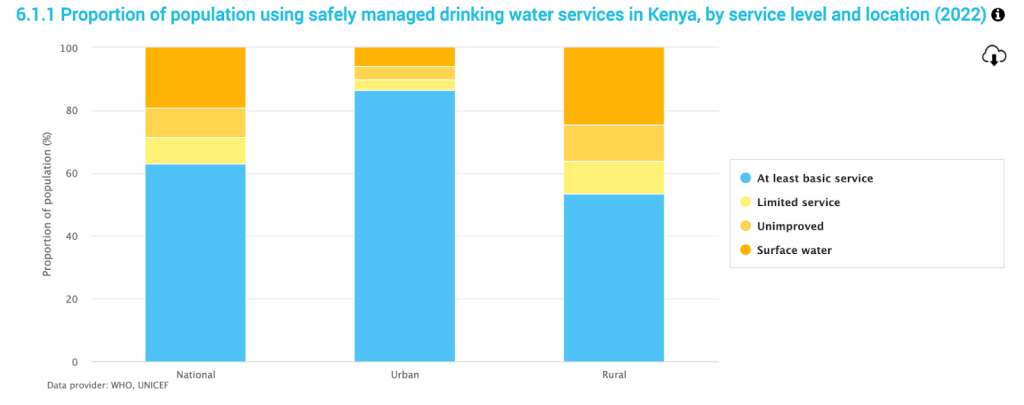
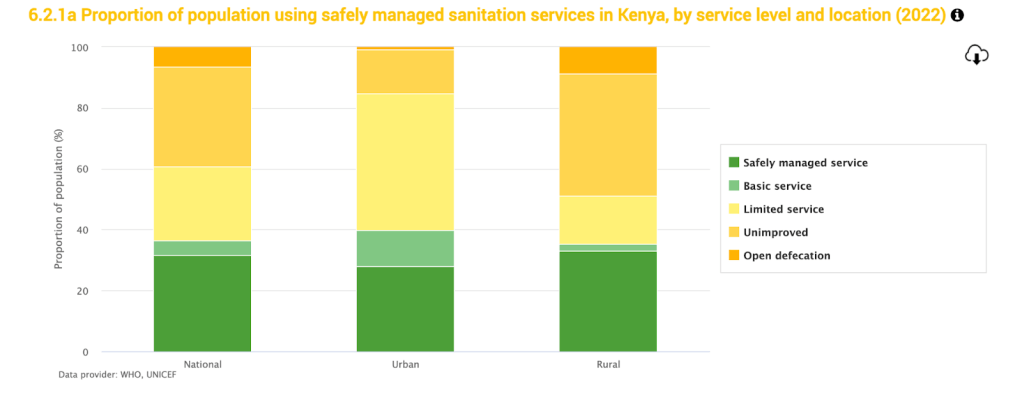
A current snapshot of Kenya shows the country’s population is vastly spread out among the differing regions. 72% of the current population resides in rural areas, which account for most of the ASAL lands in the country. Most of the country’s economy depends on agriculture, with 22% of the 233 billion USD GDP being contributed to agricultural endeavors alone. With such a heavy focus on agriculture, it is not surprising that water quality ranks high at 87%. (monitored bodies of water are listed as having good ambient water quality) Proportions of the population with access to clean drinking water has been trending upwards since the early 2000’s – as well as improved sanitation infrastructure overtime. However with these trend increases, most of the progress has been basic or limited service. Specifically in rural areas, the services of drinking water as well as sanitation are limited in nature, with rural areas having a significant proportion (9%) of residents practicing open defecation, and 38% having no WASH facilities at all.
It is to be noted that policy for water sanitation implementation is operating in a devolved framework. Current national policy puts county governments, therefore municipalities by proxy, in charge of waste management and water sanitation infrastructure. While Kenya Vision 2030 highlights the need for devolution of SDG management to the county levels for increased community participation, a large caveat to this management style is the lack of specific SDG funding being allotted to counties to solve water sanitation issues. Funding remains one of the biggest factors in the failed realization of upgraded water facilities for Kenyan citizens. Kenya 2030 highlights the need for $12.1 billion USD to complete all WASH related initiatives by the target deadline, yet the funding falls short with a national budget allotment of $5.6 billion USD. The national funding is also inequitable, it is noted that Lamu, Mombasa, and Khalifi counties need the most assistance in terms of water infrastructure capacity building, yet do not receive adequate funds to get them to the current national standards.
PROPOSED STRATEGY
It is recommended that the IATC conduct a two pronged approach in order to increase the level of development needed to hit 2030 targets for water sanitation infrastructure capacity building. The two sides of this strategy are both financial and social in nature while elevating the importance of private sector partnerships:
- Foster an inter agency partnership with USAID’s WASH-FIN to bridge the current $7 billion USD gap in water sanitation financing initiatives in new sources of market financing initiatives. (Must do this equitably taking into account different counties water sanitation issues)
The recommendation is to utilize WASH-FIN’s expertise with water service partners (WSPs) and private sanitation companies in order to bridge the current financial gap for the Kenyan government. WASH-FIN can provide the Kenyan government with technical support to increase capital investments for water service providers. WASH-FIN should bridge the gap between low funded WSPs in the counties by facilitating all transactions between WSP’s and the county governments. This can provide increased knowledge sharing between the different utilities and actors involved, including the Water Services Regulatory Board (WASREB) who is the national regulator.
Within Kenya, there has been a pre-existing partnership with WASH-FIN that has resulted in prior successes. In 2021, WASH-FIN helped mobilize over $16.5 million USD into the water and sanitation sectors, with 23,952 people gaining access to basic sanitation services. This evidence is critical as it shows that there is a need for WASH-FIN within the country as well as proof for a scale up of partnership initiatives.
- Reaffirm local government control and participation in WASH initiatives by prioritizing local stakeholder’s concerns and progress in semi-annual subnational SDG 6 hearings.
Semi-annual subnational hearings spearheaded by the Kenyan Private Sector Alliance (KESPA) – who are also a part of the IATC – will allow the Kenyan government to facilitate concerns from the county governments about the new WASH-FIN initiatives. Representatives from the national government through KESPA and the IATC will hold place for county governments to cite current WASH initiatives and progress within their respective counties. This is intended to facilitate cross governmental conversation whilst upholding the standard of county governments running their own waste management and water initiatives.
TIMELINE
Both of these initiatives are recommended to commence as in tandem with one another. Timeline wise, there are six years until we reach the 2030 milestone for Kenya Vision. The breakdown of these strategies should follow this general outline.
- 2024: Approval of the above strategy, necessary to continue the work. Stakeholder analysis will be conducted and SWOT analysis of the proposed strategy initiated. Stakeholder buy in is garnered during this initial period. Immediate partnership with WASH-FIN reinstated with knowledge of scale up of prior initiatives.
- 2025: Stakeholder Engagement is critical to the success of this strategy. Conducting the first series of initial stakeholder meetings will ensure commitment and alignment across the differing governmental levels, private sector, and community stakeholders. It is also pivotal to begin capacity building programs for Kenyan WSPs and local government agencies, while focusing on formalizing the partnership with WASH-FIN.
- 2026: $1 billion USD target reached using WASH-FIN financing objectives. During this time IATC should start construction and infrastructure rehabilitation of critical WASH infrastructure, starting with coastal counties (Mombasa and Lamu) in the most need of improving basic water sanitation.
- 2027: Review national and county policy to enhance WASH governance and management. Continue semi-annual stakeholder meetings while scaling up community initiatives. This is where the government can utilize funds to focus on WASH education and active participation in ongoing large scale infrastructure projects.
- 2028: $4 billion USD target reached through WASH-FIN capacity building. This is where there will be enough funds to launch sustainability programs at the county level, aimed at ensuring long term maintenance of the pre-constructed WASH infrastructure. Continue the semi-annual SDG 6 hearings with the differing levels of government.
- 2029: This is the time where the majority of the planned WASH infrastructure is completed. This is also the time where it is necessary to establish mechanisms for financial sustainability of WASH services such as tariffs and taxes. A finalized report/ comprehensive review of the strategies impact on improving accessibility and quality of WASH infrastructure in the differing counties.
- 2030: $7 billion USD target reached through the proposed strategy, ensuring all planned projects are fully funded. This is the time where reports of the achievements through SDG 6 targets are written and published. It is necessary to outline strategies for post 2030 – such as continuing semi-annual governmental stakeholder meetings in regards to WASH infrastructure updates.
CONCLUSIONS
While expansive, water sanitation development targets within Kenya can be reached by the proposed timeline. Improvements are already being made year after year within the country, and with reaffirmed target areas that reassure the county governments proper financing will be allotted to complete necessary assistance measures. This strategy will be implemented with the current Kenyan governance system in mind, considering the need for continued re-affirmation of local governance and community participation in SDG initiatives.
Layla Bellissimo, MPA
FIND THE ORIGINAL PDF BELOW.
 Bellissimo
Leave a comment